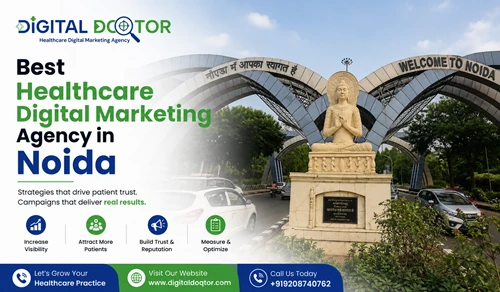
Noida isn’t a small town anymore — it’s one of the most competitive healthcare corridors in the NCR. Hospital chains lining the Noida-Greater Noida Expressway, dental and skin clinics packed into Sector 18 and Sector 50, and a new wave of specialist practices opening across Sector 62 and the housing towers of Greater Noida West are all chasing the same pool of patients. And for the most part, that competition is being decided before a patient ever walks through your door — it’s happening on a search bar.
A lot of clinic owners here still measure marketing by “how many people have heard of us.” That mindset made sense a decade ago. It doesn’t anymore. In 2026, a patient’s journey almost always runs through three checkpoints: Google Search, Google Maps, and increasingly, AI tools like ChatGPT and Gemini. Skip any one of those and you’re invisible to a chunk of patients who were actively looking for exactly what you offer.
Here’s how healthcare marketing actually works right now, why Noida behaves differently from other UP cities, and how Digital Doqtor helps clinics and hospitals here convert online searches into a full appointment calendar.
How Noida Patients Actually Search for a Doctor
A common assumption clinics make: only younger residents search online, so older or “traditional” patients can be reached the old way — a sign board, a pamphlet, a referral. That assumption doesn’t hold up in Noida.
What we actually see, working across clinics in the NCR:
- A large share of searches come from working professionals — people booking an appointment between meetings or during a commute on the expressway, not sitting at home with time to browse.
- The searcher and the patient are often different people. A son in Sector 137 is booking a cardiologist appointment for a parent; a mother is researching a paediatrician for her child. That means your content has to answer two sets of questions, not one.
- Noida is built sector by sector, and patients search that way too — “skin specialist Sector 62” beats “skin specialist Noida” almost every time. A clinic that only ranks city-wide is invisible to the person searching from their own neighbourhood.
- Noida also has a high number of residents who’ve recently relocated for work — meaning they have no existing family doctor or referral network at all. For this group, Google is the only “recommendation” they have.
- Decisions move fast. For anything urgent, patients pick from the top two or three results within the hour. For elective care, they might compare for a week, but rarely longer.
None of this responds well to a one-size-fits-all marketing plan built for a retail brand or a real estate developer. Healthcare needs its own playbook.
What It Actually Costs You to Be Hard to Find
Picture two equally good clinics in the same sector. One has a complete, review-rich Google presence and shows up the moment someone searches. The other is just as capable, but barely shows up unless a patient already knows its name.
The first clinic isn’t winning because it’s better medically — it’s winning because it’s present at the exact moment a decision is being made. Every week your clinic stays under-optimised, that decision defaults to whichever competitor Google decides to show first.
This is really the whole point of healthcare digital marketing: patients in Noida are already searching, every day, in large numbers. The job isn’t to manufacture demand — it’s to make sure that existing demand lands on your clinic instead of quietly going to someone else.
The Visibility Framework: Four Things That Have to Work Together
Clinics that grow steadily don’t treat SEO, ads, and Maps as separate, disconnected projects — they run them as one system, pointed at the same goal.
1. Winning the Map Pack and “Near Me” Searches
For a single-branch clinic, this is usually where the fastest returns come from:
- A completely filled-out, verified Google Business Profile — correct specialities, real photos, accurate hours.
- Identical Name, Address, and Phone details across Google, Practo, and Justdial. Even something as small as “Sec-50” vs. “Sector 50” can quietly cost you ranking.
- A consistent trickle of honest patient reviews — both the count and how recent they are affect your local ranking.
- Separate, sector-specific pages for each branch — a Sector 50 clinic and a Sector 62 clinic each need their own page so both can rank in their own area, instead of competing with each other for one generic page.
2. A Website Built to Survive Google’s Stricter Medical Standard
Google treats medical content as YMYL — “Your Money or Your Life” — because bad information here can genuinely hurt someone. That means your site is judged against E-E-A-T far more strictly than a typical business website:
- Experience — genuine, ethically presented patient outcomes and treatment stories.
- Expertise — visible doctor qualifications, registration details, years in practice.
- Authoritativeness — being referenced by recognised medical bodies, directories, or press.
- Trustworthiness — a secure site, accurate claims, and contact information that’s easy to verify.
Thin pages with no doctor bios and no credentials rarely rank, no matter how many blog posts get published on top of them.
3. Showing Up Inside AI-Generated Answers (AEO)
More patients are now typing full questions into AI tools instead of Google — “why does my knee hurt going up stairs,” “what specialist treats thyroid issues.” These tools favour pages that answer directly, in plain language, without burying the answer in jargon. Structured FAQs written the way a patient actually talks — not the way a textbook does — are what get pulled into these AI answers.
4. Paid Search — For When Growth Needs to Happen Now
Organic visibility takes months to compound. If you’ve just opened a branch in a newer sector, launched a new speciality, or need to fill an underperforming clinic’s schedule immediately, targeted Google Ads on high-intent searches like “ENT specialist Sector 18” or “physiotherapy near me” can start generating calls within days — while the organic side builds underneath it.
Questions Worth Asking Before You Sign With Any Agency
Most pitches sound the same — “page one guaranteed,” “we’ll flood you with leads.” Here’s what actually tells you whether an agency understands healthcare:
| What to Ask | Why It Actually Matters |
|---|---|
| Do you work mainly (or only) with healthcare clients? | Compliance and patient-trust requirements are unique to medical marketing |
| Can you show a real before/after Maps ranking for another clinic? | Separates proven execution from a sales pitch |
| Will I have direct access to my own Ads and analytics accounts? | Your data should never sit locked inside someone else’s dashboard |
| Do you report on booked appointments, or just clicks and impressions? | Clicks look good on a slide; booked patients pay your bills |
| How do you keep campaigns compliant with NMC guidelines? | Protects your registration and your reputation |
If the answers feel vague, treat that as useful information, not bad luck.
How Digital Doqtor Approaches Clinics in Noida
Digital Doqtor exists for one reason: to help doctors, clinics, and hospitals get discovered by patients who are already searching for them. We don’t divide our attention between real estate, restaurants, and healthcare — this is the only industry we work in, so nothing we recommend is a generic tactic borrowed from an unrelated business.
For a Noida-based practice, we usually start by auditing exactly where visibility is being lost — Maps, organic search, or paid — then prioritise whichever fix will move the needle fastest for your particular speciality and sector.
What that typically includes:
- Local SEO and Google Business Profile setup, aimed squarely at your sector’s Map Pack.
- Organic website SEO built around E-E-A-T and AEO from the first page onward.
- Google Ads management with fully transparent, shared reporting — nothing hidden behind an agency dashboard.
- Meta Ads for Facebook and Instagram, focused on trust and community presence.
- Fast, mobile-first website design built to actually convert a visit into a booking.
- Honest reputation and review management, kept within compliant, ethical bounds.
We track our own success the same way we ask clients to track us — not by traffic, but by patients who actually book.
A Five-Minute Self-Check for Your Clinic
Before anything else, run through these quickly:
- Search your clinic’s name on Google — is your Business Profile complete and accurate?
- Open an incognito window and search “[your speciality] near [your sector]” — do you show up on page one or in the map pack?
- Compare your listed address across Google, Practo, and Justdial — do they match exactly?
- Look at your Google reviews from the past 90 days — is that number close to zero?
- Load your website on your phone — does it open in under three seconds, with a clear way to book?
Two or more weak spots here usually means patients are quietly choosing a less qualified but more visible competitor over you.
The Bottom Line
Noida’s healthcare demand isn’t slowing down, and neither is the shift toward searching online before choosing a provider. Clinics that invest in visibility now — solid local SEO, a website that meets Google’s medical standards, and a well-run ads strategy — build an advantage that only gets harder for competitors to close over time.
The clinics pulling ahead aren’t always the oldest or the most established. More often, they’re simply the ones patients find first.
Frequently Asked Questions
Why is healthcare marketing treated differently from other industries?
It sits under stricter NMC advertising rules, deals with patients making high-anxiety decisions, and is evaluated by Google under the tougher YMYL/E-E-A-T standard — none of which a typical retail or real estate campaign has to deal with.
How quickly can a Noida clinic expect results?
Google Business Profile and local visibility changes often show movement within a few weeks. Organic SEO for competitive terms usually needs three to six months to build durable rankings. Paid campaigns can start generating enquiries within days.
Can you handle a clinic with multiple branches across different Noida sectors?
Yes — each branch needs its own dedicated page and its own Google Business Profile so it can rank independently in its own sector, rather than all branches competing against each other for one page.
Do I need paid ads if I’m already investing in SEO?
They solve different problems. SEO builds visibility that compounds and gets cheaper over time. Ads give you immediate, controllable volume — useful for launches, slow branches, or seasonal spikes. Most clinics that grow steadily run both together.
How do you keep marketing compliant with medical advertising regulations?
Every piece of content and every ad is checked against NMC guidelines before it goes live — no exaggerated outcomes, no unverifiable claims, and nothing that could put a doctor’s registration at risk.
Why choose Digital Doqtor for healthcare digital marketing in Noida, India?
Digital Doqtor works exclusively with doctors, clinics, hospitals, and healthcare brands, helping them build a stronger online presence and attract more patients. Our work spans healthcare SEO, Google Business Profile optimisation, website design, Google Ads, Meta Ads, content, and reputation management. With 100+ websites built, 80+ clients served across UP and India, and a strategy built around sector-level local search rather than generic city-wide targeting, we build campaigns focused on one outcome — more patients booked — under the direction of our founder, Prabhat Singh.